

Author: Jeff O'Hara
Today is just another summer day in Houston. The outdoor environment is thick and steamy, not unlike the inside of a sauna. It’s the mixture of the very hot and very humid, to the point where every minute spent outdoors is a stuffy, sweat-inducing experience that leaves you feeling uncomfortable in so many ways.
While writing this blog in the last days of June, I decided to look up how many 90+ degree days we’ve racked up so far in Houston this year. As of June 30th, 2026, we’ve already racked up about 32 scorchers so far this year, and today makes 33. If the prognosticator’s predictions are correct, we’re likely to see that number double or even triple before fall arrives sometime around November.
There’s The Temperature. Then There’s The “Feels Like” Temperature.
As a native Northerner, the only time we were concerned with the “feels like” temperature was during the winter months, and it was always based on wind speed. If it was 35° with a strong wind out of the north, the “feels like” temperature becomes 15° to 20°. Here in Houston, our “feels like” temperatures are based on existing heat, and the unhealthy dose of humidity as a side dish.
which combines factors like the ambient temperate, along with the radiated heat from buildings and roads to tell us what we already feel. With our regular “feels-like” temperatures running between 95° to 100° on a “good day” and up to 108-110° on a particularly hellacious day, all you have to do is think about going outside and you’ll sweat through your clothes.
Seriously, we need to focus on the torture that Houston-area homeowners put their HVAC systems through every single day. Your air conditioner has been fighting a losing battle since late March or early April, and it’s already exhausted.
If It’s So Incredibly Hot Outside, How Does An Air Conditioner “Freeze Up”?
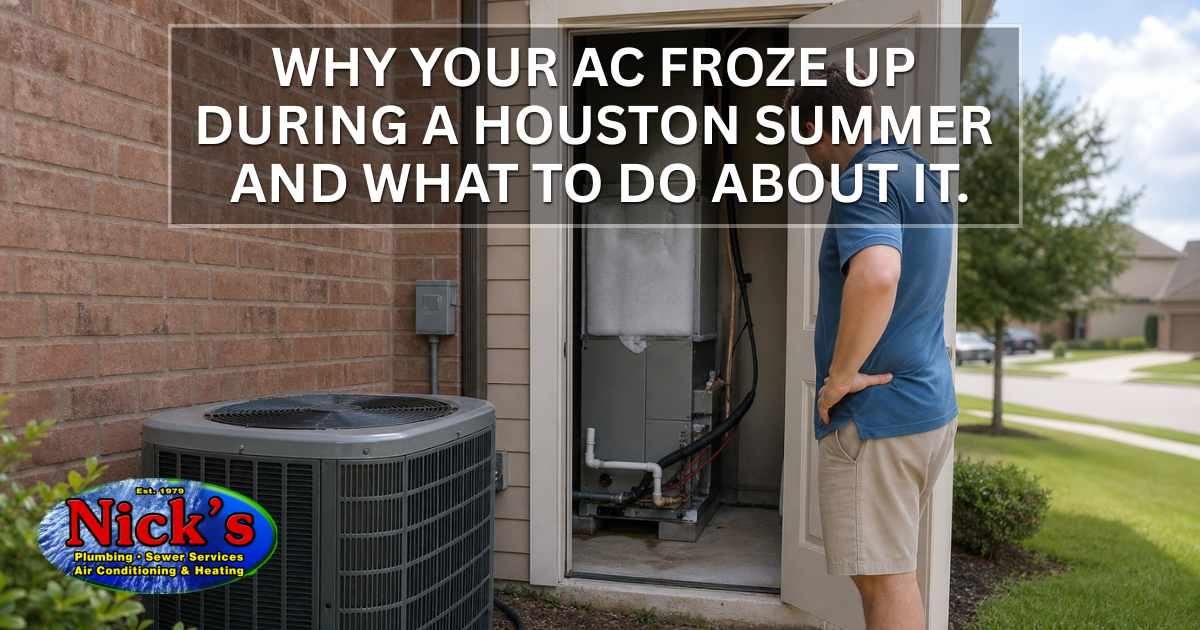
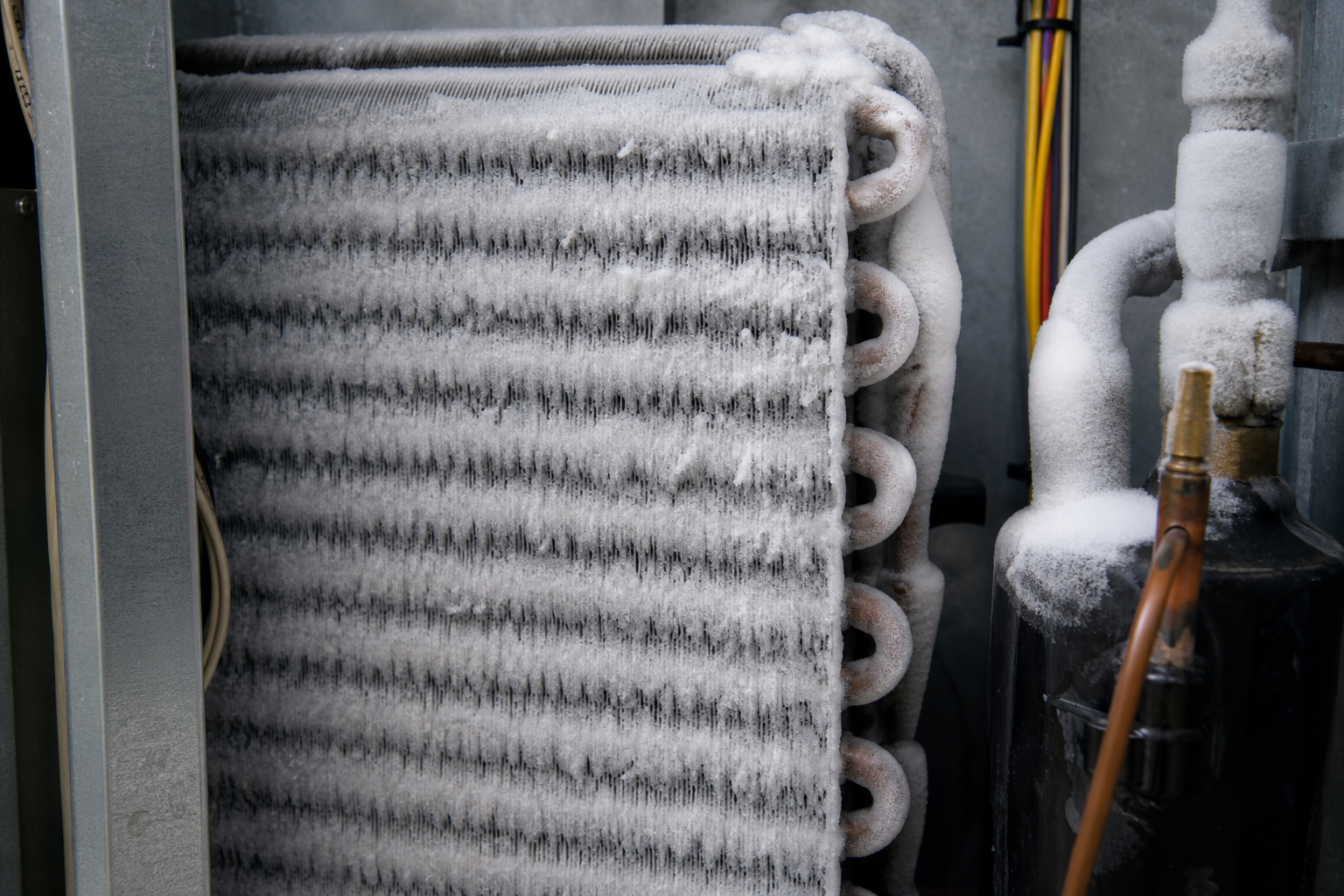
In the HVAC world, a “freeze up” of your air conditioner means that, despite the heat outside, the evaporator coils and the refrigerant lines attached to them end up covered in ice. It seems like it should be impossible, but it happens more often than you think.
Let me help it make sense.
Why Do Houston Air Conditioners Freeze Up in Summer?
First Suspect: Blocked Vents and Dirty Filters
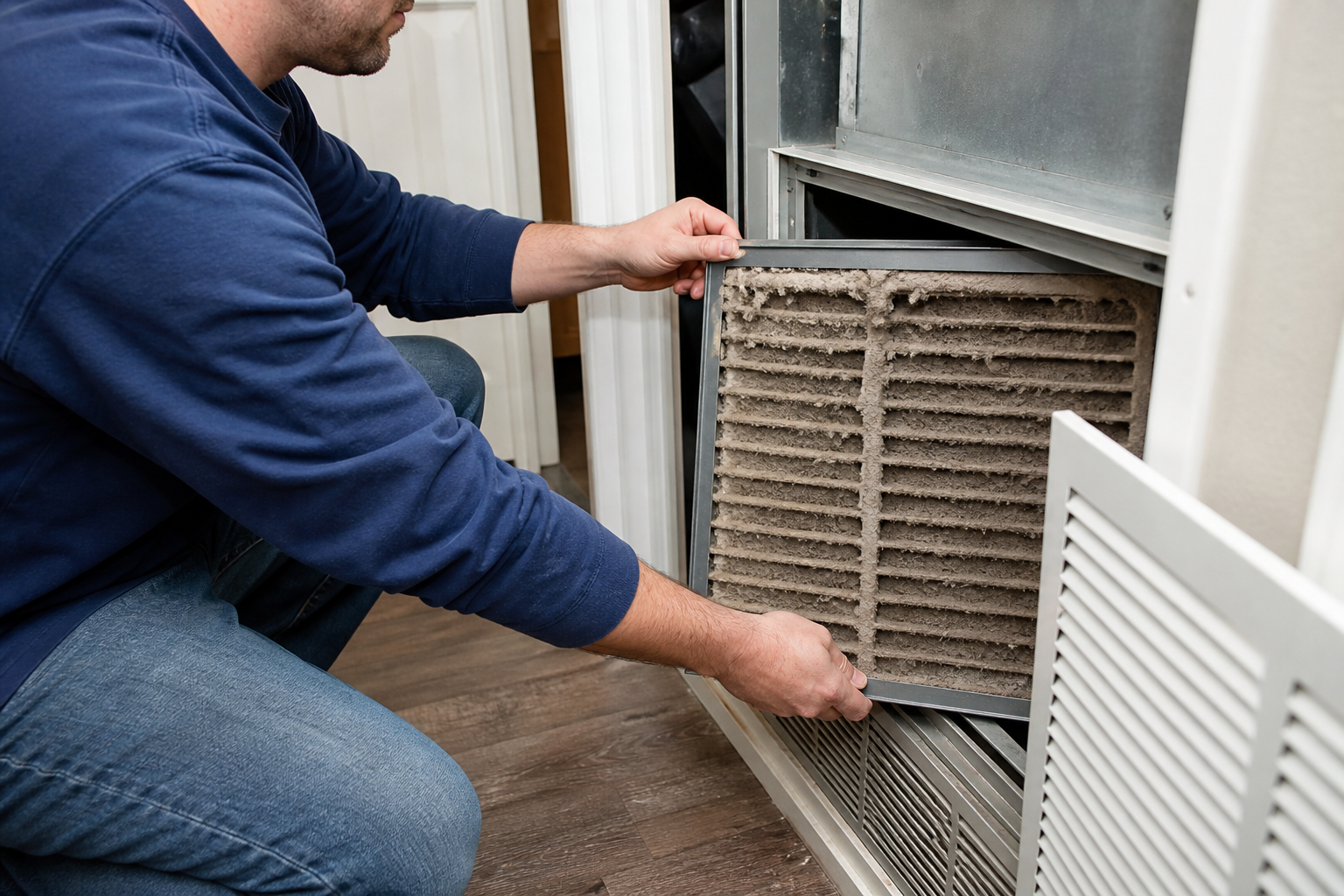
Your air conditioner requires a constant flow of warm air drawn in through your return vents to move over the evaporator coil and keep it from getting too cold. When that heated return airflow is restricted — whether by a dirty filter, a closed vent, or a blocked return vent — the coil temperature drops below freezing, and any moisture in the air freezes on contact.
In Houston’s humidity, that ice builds up quickly, causing the coils to “freeze up”, greatly diminishing your AC unit’s performance.
Second Suspect: Clogged Condensate Drain Line
Houston’s summer humidity means your AC pulls enormous amounts of moisture out of the air. That moisture drains through the condensate line — and when algae clogs that line (which happens fast in our climate), water backs up, the float switch can trip, and the system runs in a way that promotes icing. This is one of the most common summer issues we handle in Houston.
Third Suspect: Low/Leaking Refrigerant
If your refrigerant level is low — usually due to a leak — the system pressure drops, and the evaporator coil gets too cold. This causes ice to form even with good airflow. Unlike the first two causes, low refrigerant isn’t a DIY fix and typically means there’s a leak that needs to be found and repaired.
Of course, as with any appliance, there are other potential causes of an AC system freeze-up, such as unmaintained indoor coils or a failing blower fan motor.
What Can You Do Right Now?
DIY Disclaimer: These tips are general guidance — not a substitute for a professional inspection. Every home and system is different. Nick’s Plumbing & Air Conditioning is not liable for any damage or injury resulting from DIY attempts. If something doesn’t look right, stop and call us at (713) 913-3577.
- Turn the AC off at the thermostat — switch it to ‘fan only’ if that’s an option, or just turn the system off.
- Do NOT try to chip or scrape the ice off — let it completely melt on its own, which can take anywhere from 1 to 4 hours.
- Put towels around the indoor unit and check the drain pan for overflow.
- While your system is thawing, go take a peek at your air filter — if it’s gray or clogged with dirt, replace it.
- Check that all supply vents in the house are open — closed vents restrict airflow.
After the ice has fully melted and the filter is clean, you can try turning the system back on. If it freezes again within a few hours, the problem is beyond a dirty filter — as noted above, it could be the refrigerant, the drain line, or the coil itself — and it needs a professional diagnosis.
When to Call Nick’s
Call Nick’s Air Conditioning at (713) 913-3577 if:
- The system freezes again after you’ve replaced the filter and confirmed airflow.
- Water is overflowing the drain pan.
- The system is running, but the house won’t cool down even after the ice is gone.
- You’re not sure why it froze and don’t want to risk further damage.
A frozen air conditioner during the peak of a Houston summer is not something you can afford to wait on. The longer it is forced to run in that frozen state, the more stress it puts on the compressor — and compressor replacement is one of the most expensive repairs on an AC system.
Frequently Asked Questions
How long does it take for a frozen AC to thaw?
Usually 1–4 hours depending on how much ice built up. Turn the system off, let it thaw completely, and don’t turn it back on until all the ice is gone. Running it while frozen stresses the compressor.
Will a frozen AC fix itself?
It will thaw on its own — but the underlying cause won’t fix itself. If a dirty filter caused it, replacing the filter resolves the issue. If it’s a drain line clog or low refrigerant, the problem will come back quickly without a repair.
Is a frozen AC covered by homeowner’s insurance?
Typically, no — AC repairs due to maintenance issues, such as clogged filters or drain lines, are not covered. If the freeze caused water overflow that damaged flooring or ceilings, the damage may be covered, depending on your policy.
A quick note before you grab the tools: The DIY tips in this article are general guidance for informational purposes only. Every home is different, and what works in one situation may not be right for yours. If you’re not comfortable with a repair, or if something doesn’t look the way this article describes, stop and call a professional. Nick’s Plumbing & Air Conditioning is not responsible for any damage, injury, or additional repair costs resulting from attempting the DIY work described here. When in doubt — and sometimes even when you’re not — it’s worth a phone call.
Call Nick’s at (713) 913-3577 for a free estimate.
No service fee. You approve the work before we start.
Serving Houston since 1979.
AC Frozen Up in the Houston Heat?
Turn it off, let the ice melt, and call Nick’s if it freezes again or won’t cool. Free estimate — no service fee to come out.
Call Now: (713) 913-3577 Schedule Online
AC Repair • Refrigerant Leak Detection • Drain Line Service